
By 2027, Federal Law Could Let Your Car Decide If You’re Allowed to Drive
New federal vehicle safety requirements could push automakers toward impaired driving detection technology, raising major questions about privacy, false readings, vehicle data, and who may be responsible after a serious crash.
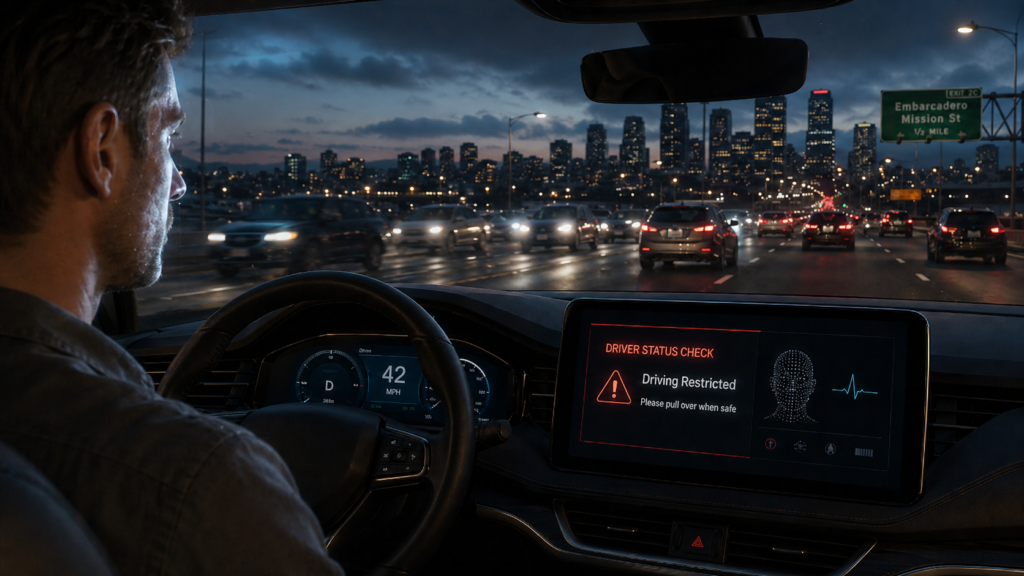
Modern cars already do more than most drivers realize. They can warn you when you drift out of your lane, brake before a collision, monitor blind spots, track your speed, detect sudden movement, and store data about what happened moments before a crash.
But by 2027, vehicle safety technology could move into a much more controversial area: systems designed to detect whether a driver appears impaired and prevent the vehicle from being operated.
The idea comes from the 2021 Infrastructure Investment and Jobs Act, which directed federal regulators to develop a safety standard for “advanced drunk and impaired driving prevention technology” in new passenger vehicles. NHTSA has continued studying the issue, although its recent report to Congress made clear that the technology still faces major challenges involving accuracy, reliability, and real-world use.
On paper, the goal sounds reasonable. If a car can stop an impaired driver before he or she causes a crash, lives could be saved. Drunk and impaired driving continues to be one of the most dangerous problems on American roads, and any technology that helps reduce serious crashes deserves attention.
But the legal and practical questions are much harder.
What happens if the car gets it wrong? What happens if a sober driver is locked out of his or her own vehicle because of a false reading? What happens if the system fails to stop an impaired driver and someone gets seriously injured? And after a crash, could the vehicle’s data become evidence in a personal injury claim?
These are the questions that may matter most as cars become smarter, more connected, and more involved in decisions that used to belong entirely to the driver.
The Promise Behind Impaired Driving Detection
The purpose of impaired driving prevention technology is simple: prevent dangerous driving before it starts. Instead of waiting for a police officer to stop a suspected drunk driver, or for a crash to happen, the vehicle itself may be designed to detect signs of impairment.
Some systems may focus on alcohol detection. Others may look at driver behavior, steering patterns, lane position, reaction time, eye movement, or other signs that a driver may not be safe behind the wheel.
Unlike traditional ignition interlock devices, which usually require a person to blow into a device before starting the car, newer systems may be designed to work passively in the background. That means the driver may not have to actively do anything for the system to monitor their condition.
If the technology works correctly, it could prevent some DUI-related crashes before they ever happen. That is the strongest argument in favor of the law.
But safety technology is only helpful when it is accurate, reliable, and used fairly.
What If the Car Makes the Wrong Call?
No technology is perfect. That is where the concern begins.
A system that falsely detects impairment could prevent a completely sober person from driving. That may sound like a minor inconvenience until you imagine someone trying to get to work, pick up a child, attend a medical appointment, or respond to an emergency.
The opposite problem is just as serious. If a system is supposed to detect impairment but fails to stop a drunk or drug-impaired driver, and that driver causes a crash, the injured person may have new questions about what went wrong.
Was the driver impaired? Did the vehicle detect anything unusual? Did the system issue a warning? Did it store data? Was the system defective? Did it fail to work the way it was advertised?
Those questions could become important in future car accident cases, especially if the crash involves a newer vehicle equipped with advanced driver monitoring or impairment detection technology.
Why Vehicle Data Could Matter After a Crash
Many modern vehicles already collect information that may be relevant after a collision. Depending on the vehicle, that data may involve speed, braking, acceleration, steering input, seat belt use, airbag deployment, crash timing, and the activity of driver assistance features.
If driver monitoring and impairment detection systems become more common, that data may become even more important.
For an injured accident victim, vehicle data could help show what happened in the moments before the crash. It may help answer questions such as whether the driver braked, swerved, ignored warnings, drifted out of a lane, or showed signs of unsafe driving.
In some cases, the data may support a claim that the other driver was negligent. In other cases, it may raise questions about whether a safety system failed, whether a warning was ignored, or whether the vehicle itself played a role in the crash.
This does not mean every car accident claim will become a technology case. Many crashes still come down to familiar forms of negligence, such as speeding, distracted driving, drunk driving, tailgating, unsafe turns, or failure to yield.
But as vehicles become more advanced, preserving evidence early may become even more important.
Could a Safety System Failure Affect a Personal Injury Claim?
If someone is injured in a crash caused by an impaired driver, the claim usually focuses on the driver’s conduct. The injured person may pursue compensation for medical bills, lost wages, pain and suffering, property damage, and other losses caused by the collision.
However, future cases may involve another layer of investigation.
If a vehicle is equipped with technology that is supposed to detect impairment or unsafe driving, a personal injury lawyer may need to ask whether that technology worked properly. If the system failed to detect an impaired driver, failed to warn the driver, failed to limit vehicle operation, or malfunctioned in some way, the case could become more complex.
That does not automatically mean the automaker or technology provider is responsible. These cases would depend heavily on the facts. But it does mean that serious crashes involving newer vehicles may require a deeper investigation into both the driver’s conduct and the vehicle’s performance.
The Privacy Question Is Not Going Away
There is also a larger concern that many drivers are thinking about: privacy.
If a vehicle can monitor impairment, driver attention, eye movement, steering behavior, braking, speed, or other activity, who gets access to that information? Is it stored? Can insurance companies use it? Can it be requested after a crash? Could it affect a claim?
Those questions are likely to become more important as cars collect more data.
For accident victims, vehicle data may be useful if it helps prove what happened. For drivers, the same data may raise concerns about privacy, misuse, or being judged by a system they do not fully understand.
That tension is part of what makes this issue so important. The technology may improve safety, but it may also change how car accident claims are investigated and how responsibility is determined.
Why This Matters for Newark, CA Drivers
Drivers in Newark, Fremont, Union City, Hayward, and throughout the Bay Area already face heavy traffic, crowded intersections, freeway congestion, distracted drivers, and impaired drivers. A serious crash can happen in seconds, but the consequences can last for months, years, or longer.
When someone is injured because another driver was careless, reckless, or impaired, the legal claim should look at the full picture. That may include the police report, photos, video footage, witness statements, medical records, insurance coverage, and, when available, vehicle data.
As technology becomes more involved in driving, that full picture may include questions that did not exist in older car accident cases.
Did the vehicle detect unsafe driving? Did it record the driver’s behavior? Did it issue warnings? Did the driver ignore them? Did a safety system fail? Was important data preserved before it disappeared?
These are the kinds of questions that may become more common in future personal injury claims.
Insurance Companies May Still Push Back
Even when the other driver appears clearly at fault, insurance companies do not always make the process easy. They may dispute the seriousness of the injuries, question the need for medical treatment, challenge lost wage claims, or try to argue that the accident did not cause all of the victim’s damages.
If advanced vehicle data becomes part of more accident claims, insurance companies may also try to use that information in ways that benefit them.
That is why injured victims should be careful after a serious crash. What seems like a straightforward accident claim may involve more evidence, more technical questions, and more insurance company pushback than expected.
A Newark, CA personal injury lawyer can help review the evidence, deal with the insurance company, and pursue the compensation available under California law.
Did You Know?
A DUI-related crash can create serious personal injury issues, but an arrest or citation does not automatically guarantee that the injured victim will be treated fairly by the insurance company.
The insurance company may still question the value of the claim, the severity of the injuries, the cost of medical care, or whether future treatment is necessary. In more serious cases, it may also take time to understand the full impact of the accident.
That is why a detailed investigation matters. Photos, medical records, police reports, witness statements, video footage, insurance information, and vehicle data may all help support a stronger claim.
The Jagroop Law Office, Inc. helps injured accident victims understand their rights after serious crashes, including cases involving impaired driving, distracted driving, reckless driving, and other forms of negligence.
Speak With a Newark, CA Personal Injury Lawyer After a Serious Crash
By 2027, federal vehicle safety requirements could push cars further into the role of monitoring drivers and preventing unsafe operation. That may help reduce impaired driving crashes, but it may also raise new questions after serious accidents.
If you were injured in a crash caused by another driver, it is important to understand your rights before dealing too heavily with the insurance company. A serious car accident claim may involve more than just proving who hit who. It may involve medical evidence, insurance coverage, witness statements, crash data, and the long-term impact of your injuries.
The Jagroop Law Office, Inc. represents accident victims in Newark and throughout the surrounding Bay Area. If you or someone you love was hurt in a serious car accident, contact the firm to discuss your case and learn what steps may be available to protect your rights.
